An Expert Review of A Fire Upon The Deep
Over the years I’ve read A Fire Upon The Deep a couple times so here’s some stuff about it. I often see people get basic outright stated plot details wrong about it, so maybe this can be a cheat sheet if you believe it all. This page is in no specific order with no grand flow or purpose, so just relax and enjoy.
A Fire Upon The Deep is anchored in a future where the only notable surviving branch of humanity is descended from Norway, so everything human-related in the present-day setting of the novel has a nord-tinge to it (much like how OSC decided the future is all going to be about Portugal and Brazil or something similar because “write what you know”).
Some important writing notes about the book up front:
The text directly tells you what is happening with the mystery plot lines, but it isn’t a mystery novel. Details provided from character-level musing or guessing via the narration “speculating” is often correct (on purpose, obviously). During your first read through a lot of the character “guessing” doesn’t register as what is actually happening in the story because it sounds like they are just speculating on reasons and causes about what is happening, but 3/5 guesses they make are accurate. I think the repeated writing of mixing in true guesses with false guesses is what confuses readers about what actually happened in the book overall, but almost everytime a character “openly muses about what may be happening” they are correct.
The opening of the story, I didn’t even realize until recently, isn’t inside the story at all. The opening italicized line is just Vinge directly writing onto the page as the author a note about “how do I write a story with characters ranging from god-level motivations to distributed hiveminds to human-scale thought processes?”
The book opens:
How to explain? How to describe? Even the omniscient viewpoint quails.
I’d argue, as the book is written in a 3rd Person Omniscient voice, the opening italicized line is The Author musing about “how do I even write this from an omniscient viewpoint when some of the characters are post-singularity intelligences themselves?? anyway, here we go…”
Following the opening line is the opening prolog.
The opening prolog of A Fire Upon The Deep is one of my favorite opening chapters (maybe only the States of Matter opening paragraph is secondary).
A Fire Upon The Deep opens describing a hybrid group of explorers, scientists, grave robbers, and technologists trying revive a “lost archive” in a part of the galaxy capable of sustaining supercomputing in ambient dust as easy as we breathe. You could imagine exploring a dead world with the purpose of opening a digital archive of ancient god-level creatures could be a bit risky, to say the least. If the dust around you can assemble itself into an exponentially-accelerating hyperintelligence in the time it takes you to breathe five times maybe you should double check how far you let your programs run unattended. Especially when “opening the archive” at deeper and deeper levels requires following instructions from inside the archive itself telling you what machines and programs you have to build to access more parts of it to extract more and more information using custom hardware and protocols and hypernetworks.
then hilarity ensues
A Fire Upon The Deep was written between 1989 and 1991, so it is necessarily “an artifact of its time,” but it goes out of the way to not actually describe technology very much. In modern terms, it would be a “soft technology system” from a world-building perspective. The most technical descriptions in the book are mentions of encryption and network protocols and some bitrates at mostly vague hand-wavy levels, so it doesn’t feel dated full of future mis-fire predictive context shifts constantly.
The primary conceit Vinge gives for the spread of technology in his universe is what he calls “Zones of Thought,” which are never actually explained and are actually very poorly described or outlined in the text itself. The best way I can describe Zones in Vinge’s universe: the speed of light has exceptions. The speed of light can be “worked around” at variable multiples of speed depending on where in the galaxy you are (they even outright say multiple times the “slow zone” is where 1 light year takes 1 year to cross, and “higher zones” shrink the time it takes to cross “1 standard light year” described as “50 light years per hour”), and currently, when the book starts, the zones are, roughly follow “galactic mean density” meaning the center of the galaxy has a slower speed of light than outer parts of the galaxy. The differences are so great that at the deepest, slowest zone are “the unthinking depths” where even brains can’t operate; as compared with the outer zones of a stratified “the beyond” and “the transcend” and even higher out “the Magellanic clouds.”
But they had escaped. The OOB was crippled, but they had left Relay at almost fifty light-years per hour. Each hour they were lower in the Beyond and the computation time for the microjumps increased, and their pseudovelocity declined. Nevertheless, they were making progress. They were deep into the Middle of the Beyond now.
In this part of The Beyond they could go a thousandth of a light-year on each jump — farther, but then the recompute time would be substantially worse. At ten per second that added up to more than thirty light-years per hour. The jumps themselves were imperceptible to human senses, and between the jumps the were in free fall, carrying the same intrinsic velocity they’d had on departing Relay. So there was none of the doppler shifting of relativistic flight; the stars were as pure as seen from some desert sky, or in low-speed transit. Without any fuss, they simply slid across the sky, the closer ones the faster.
Alternatively, instead of saying “the speed of light isn’t constant” we could imagine they do have a constant speed of information propagation, but with a loophole: maybe they have a subspace carrier signal hypernetwork wormhole wave capable of doing an end-run around the speed of light and the carrier signal varies in speed according to zone boundaries from basically 0 at the core out to tens to hundreds of light years per second at the outer zones (causality? never heard of it). Though, this hybrid “speed-of-light with workaround” approach doesn’t explain how even biological intelligence can’t survive the ultimate slowness and it would also mean the fundamental unit of communication is embedded subspace manipulators in every device for the upper zones to work with scalable technology as they do.
Zones are essentially continuous but also discretized, so there is “The Beyond” but also “The High Beyond” and “The Low Transcend” and “The Transcend” all having different abilities for underlying physics and intelligence as “the intelligence limiter” (speed of light / speed of causality / limit of information transmission, i’m guessing again here) can be relaxed or restricted. Through points in the novel characters muse about “are these natural occurrences? were the zones installed by even higher levels of intelligence to protect something?” to which the novel provides definitive answers to in the end.
Countermeasure: The MacGuffin That Is Not A MacGuffin
The opening prolog establishes the central premise driving the plot forward: the silly humans woke up a 5 billion year old abomination which had previously been defeated and shutdown from “living,” but the prior defeat didn’t wipe all copies of the intelligence from the local region, so the humans accidentally bootstrap it back into existence (again, they were exploring in an “upper Zone” of the Lower Transcend where exponential-intelligence-explosion is as easy as breathing); but something else happened when the evil thing started to wake up too – for some reason the archived instance of this ancient autonomous disease was also stored with a second ancient abomination capable of stopping it. Due to some combination of intentional design, coincidence, or capability spread, the Countermeasure to the evil is able to also start up at-or-before the evil Power does to such an extent the Countermeasure projects an information void around itself so the awakening evil god can’t discover it and wipe it out, so the Countermeasure provides enough of a “safety bubble” for other micro-intelligences to steal it away for later use:
“The evil is young, barely three days old.” “Still. We exist. It proves something. The humans found more than a great evil in this archive.” “Perhaps they found two.”
Vinge spotlights multiple times throughout the book the differences between “intelligence” or “capability” and “self-awareness” or “consciousness:”
The omniscient view. Not self-aware really. Self-awareness is much over-rated. Most automation works far better as a part of a whole, and even if human-powerful, it does not need to self-know.
Those feeble devices were now simply front ends to the devices the recipes suggested. The processes had the potential for self-awareness … and occasionally the need. “We should not be.” “Talking like this?” “Talking at all.”
So, the question remains. Just how complete is the Blight’s control over conquered races? I don’t know. There may not be any self-aware minds left in the Blight’s Beyond, only billions of teleoperated devices. One thing is clear: The Blight needs something from us that it cannot yet take.

This was a Transcendent machine. Ravna had read of such things: devices made in the Transcend, but for use at the Bottom of the Beyond. There would be nothing sentient about it, nothing that violated the constraints of the Lower Zones — yet it would make the best possible use of nature here, to do whatever its builder had desired: Its builder? The Blight? An enemy of the Blight?
The most frustrating part of the novel is Vinge’s insistence on vagueness without grounding the inner workings and purposes of the “hyperminds” and “transcendent intelligences.” Vinge draws a hard absolutely-no-crossing line around not writing false assumptions about things he knows he has no possibility of understanding (like the inner workings of exponentially expanding hive intelligences), so embrace the vagueness.
What is the purpose of Countermeasure though? The novel spends 95% of the book guessing or assuming what it does, then it wraps up by telling you in about 2 sentences and you almost get “understanding whiplash” and don’t have time to absorb what it was doing the entire time.
What is Countermeasure
Here’s my best breakdown of what Countermeasure is and does and isn’t and doesn’t and what we know and what we don’t know.
- the Straumers let the archive tell them how to activate the archive (rookie move)
- the archive bootstrapped The Blight but the bootstrap process also became self-aware (“the local net at the High Lab had transcended”)
- the bootstrap process activated/grew The Blight (via intentional subterfuge) but it also discovered Countermeasure (also via a second level of subterfuge)
- the bootstrap process (or their local “transcended network”) schemed the false escape to store Physical Transcendence Countermeasure on the family ship while sacrificing the remainder of the expedition’s escape as a false “the bigger, more important target” to attack
- Countermeasure is never aware and never speaks and never acts on its own (with intentionally). Only the bootstrap process, which splintered into two “ego-level processes,” then somehow became protected by Countermeasure by then installed into the Countermeasure Power not-self-aware substrate, is what we see communicate about extracting the physical Countermeasure nanobot swarm fungus and deep diving as far as they can get away from The Blight’s sphere of influence so it can have time to send for help and find somebody who can understand how to use it.
- The conclusion of the novel, when they find The MacGuffin That Is Not A MacGuffin, is also highly annoying because, off-screen, the god-man enters the ship and connects up to Countermeasure and learns about it and learns what it does and how to activate it, but we, as the audience, are not privy to any of those processes. At the conclusion, we only get his final summary of being connected to the hyperfungus as:
Pham Nuwen almost disappearing behind the other programs at work in his mind. Then, “I’m … focussing Countermeasure. I see now, Countermeasure, what it is…. It was designed by something beyond the Powers. Maybe there are Cloud People, maybe this is signalling them. Or maybe what it’s just done is like an insect bite, something that will cause a much greater reaction. The Bottom of the Beyond has just receded, like the waterline before a tsunami.” The Countermeasure glared red-orange, its arcs and barbs embracing Pham more tightly than before. “And now that we’ve bootstrapped to a decent Zone … things can really happen. Oh, the ghost of Old One is amused. Seeing beyond the Powers was almost worth dying for.”
The fleet stats flowed across Ravna’s wrist. The Blight was coming on even faster than before. “Five minutes, Pham.” Even though they were still thirty light-years out.
Laughter. “Oh, the Blight knows, too. I see this is what it feared all along. This is what killed it those aeons ago. It’s racing forward now, but it’s too late.” The glow brightened; the mask of light that was Pham’s face seemed to relax.
“Something very … far … away has heard me, Rav. It’s coming.”
“What? What’s coming?”
“The Surge. So big. It makes what hit us before seem a gentle wave. This is the one nobody believes, because no one’s left to record it. The Bottom will be blown out beyond the fleet.
In the end, even the god-man doesn’t know or tell us exactly what Countermeasure is or how it operates. We also see, obviously, Countermeasure is capable of manipulating zone boundaries for the purpose of moving zones such that Countermeasure can “pull the Transcend” down to its own level for higher operations with enough direction (and without “violating the zones” themselves because it’s not a Transcendent machine operating outside its own zone, it’s a “normal machine” capable of pushing around galactic spacetime to then enable it to act as intended (hand wavy: somehow)). Fundamentally, Countermeasure is capable of localizing part of the Transcend into any lower zone (i.e. anyplace it lands) for “Emergency Services” to activate. Even though we never know what it does or is capable of completely, we can see the effects. Countermeasure is also like an anchor point leaving, what I would imagine in modern speak, is some subspace slime trail from where it was created (High Lab) tracing down to where it currently resides (dog world, using the power of their local Sun to energize itself enough to destroy a pie-slice of the galaxy). Then when activated enough it can be used to signal “the outer races” of “hyper-galactic-powers” to initiate a patch-up job using the logged breadcrumb subspace hypertrail between Countermeasure’s “awakening point” and its current location. Basically, “from where I am to where i originated, please destroy everything between here and there by rewriting the galactic zones of thought and reducing any grey-goo-mind-stealing-virus-things back into motes of inert dust.” Compliance occurs.
The artifact abruptly contracted, and Pham moaned. “Not much time. We’re at maximum recession. When the surge comes, it will—” Again a sound of pain. “I can see it! By the Powers, Ravna, it will sweep high and last long.”
“How high, Pham?” Ravna said softly. She thought of all the civilizations above them. There were the Butterflies and the treacherous types who supported the pogrom at Sjandra Kei…. And there were trillions who lived in peace and made their own way toward the heights.
“A thousand light-years? Ten thousand? I’m not sure. The ghosts in Countermeasure — Arne and Sjana thought it might rise so high it would punch into the Transcend, encyst the Blight right where it sits…. That must be what happened Before.”
and even with all the damage and final accomplishments, Countermeasure was still just a tool and was never alive itself:
He felt Countermeasure slough toward nonexistence, its task done without ever a conscious thought.
The thing was deep in Pham’s chest, but there was no blood, no torn flesh. She might have thought it all trick holography except that she could see him shudder at its writhing. The fractal arms were feathered by long teeth, twisting at him. She gasped and almost called his name. But Pham wasn’t resisting. He seemed deeper into godshatter than ever before, and more at peace. The hope and fear came suddenly out of hiding: hope that maybe, even now, godshatter could do something about the Blight; and fear, that Pham would die in the process.
For Pham Nuwen, there was no pain. The last minutes of his life were beyond any description that might be rendered in the Slowness or even in the Beyond.
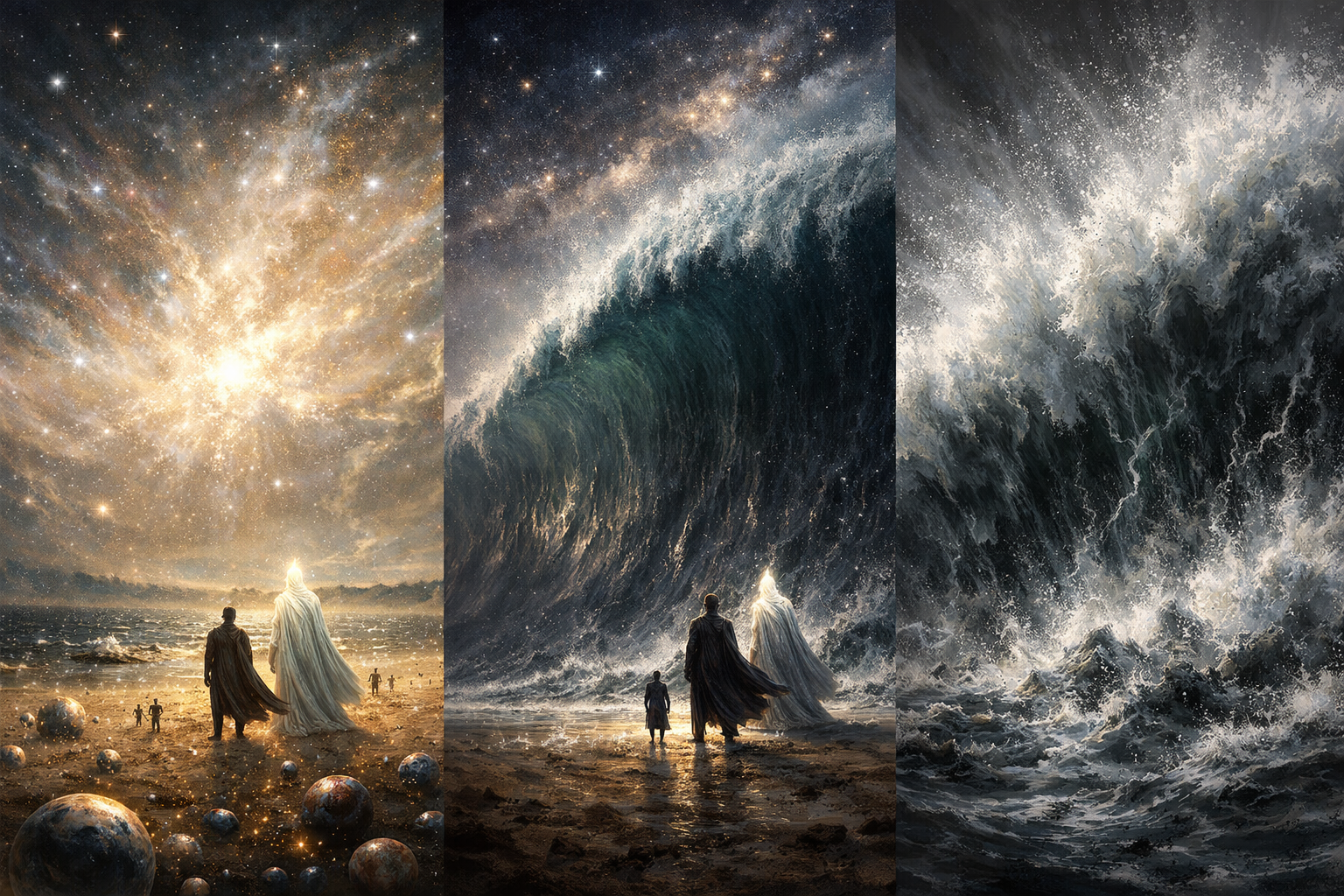
So try metaphor and simile: It was like … it was like … Pham stood with Old One on a vast and empty beach. Ravna and Tines were tiny creatures at their feet. Planets and stars were the grains of sand. And the sea had drawn briefly back, letting the brightness of thought reach here where before had been darkness. The Transcendence would be brief. At the horizon, the drawn-back sea was building, a dark wall higher than any mountain, rushing back upon them. He looked up at the enormity of it. Pham and godshatter and Countermeasure would not survive that submergence, not even separately. They had triggered catastrophe beyond mind, a vast section of the Galaxy plunged into Slowness, as deep as Old Earth itself, and as permanent.
We know some things and we don’t know some things.
We Know About Countermeasure
We know Countermeasure was taken from High Lab.
We know Countermeasure itself is not human-level self-aware. It could have a more self-contained “animal-level” awareness though.
“All the zone turbulence … that was Countermeasure trying to act, but without coordination. Now I’m guiding it. I’ve begun … the reverse surge. It’s drawing on local energy sources. Can’t you feel it?” Reverse surge? What was Pham talking about? She glanced again at her wrist — and gasped. Enemy speed had jumped to twenty light- years per hour, as fast as might be expected in the Middle Beyond. What had been almost two days of grace was barely two hours. And now the display said twenty-five light-years per hour. Thirty.
Countermeasure appears to have a computational substrate strong enough to run human-equivalent-level minds inside of it, but Countermeasure itself is not a hyperintelligence.
Countermeasure is either transcendent (or beyond transcendent) technology which, through soft-technology means, can operate outside of the high-technology magic-capable zones either through loopholes in the zone-technology system or from just storing “hyper accelerated tech” protected inside of via self-nano-assemblers which can aggressively activate when it, as they say, gets “bootstrapped into a proper zone.”
We know Countermeasure can manipulate the zone boundaries, but we don’t know the reason it randomly causes aggressive zone turbulence without a controller interfacing with it. It’s almost as if, when left unattended, Countermeasure is just brownian-motion-style reflexively causing zone surges just because it feels bored or is reaching out for attention/control/help (“store demo mode”).
Countermeasure may be like an anchor point: a source and a destination. When the god man submits his zone reallocation request, what happens is the height of the firmament (and perhaps further) is drawn down TO THE LOCATION OF COUNTERMEASURE (via the power of dimming a sun to power it) then, much like an elastic band in a slingshot pulled tight, with heaven pulled down into the center of Countermeasure; Countermeasure releases – snap. A sling shot rubber band releasing potential energy drawn into it. A galaxy-sized spring rebounding after being compressed flat. A deep slowness even deeper than Countermeasure pulled down from on high snaps back (to reality) with such a rebound energy impulse the result is higher and further than Countermeasure pulled down in the first place:
Pham Nuwen swayed in Countermeasure’s bright embrace. His voice was almost normal, the godshatter receding. “What have I done? Not much. And more than any Power. Even Old One only guessed, Ravna. The thing the Straumers brought here is the Rider Myth. We — I, it —just moved the Zone boundary back. A local change, but intense. We’re in the equivalent of the High Beyond now, maybe even the Low Transcend locally. That’s why the Blighter fleet can move so fast.”
The man’s face went blank, Pham Nuwen almost disappearing behind the other programs at work in his mind. Then, “I’m … focussing Countermeasure. I see now, Countermeasure, what it is…. It was designed by something beyond the Powers. Maybe there are Cloud People, maybe this is signalling them. Or maybe what it’s just done is like an insect bite, something that will cause a much greater reaction. The Bottom of the Beyond has just receded, like the waterline before a tsunami.” The Countermeasure glared red-orange, its arcs and barbs embracing Pham more tightly than before. “And now that we’ve bootstrapped to a decent Zone … things can really happen. Oh, the ghost of Old One is amused. Seeing beyond the Powers was almost worth dying for.”
We Don’t Know About Countermeasure

We don’t actually know how Countermeasure was instantiated. Was Countermeasure a physical artifact stored on the archive grounds? Or did the archive have instructions for building Countermeasure with intelligent transcend nanobots, the Straumer automation constructed it not knowing what it was, then they discovered it was somehow important and stole it away (arguably the ego-level programs “enhanced” by Countermeasure gained awareness and constructed the plan to escape the flowering and manipulated the situation themselves)?
It is also unclear due to Vinge Vague Speak what the High Lab library actually is: is the library just like a giant digital storage medium? Are they interfacing with a giant flash drive and figuring out how to write ancient USB-3 protocols? Or is it an entire facility they are excavating so it has hybrid physical artifacts and digital artifacts for extraction? It’s never clarified:
So now there was a tiny settlement on the surface, and they called it the High Lab. It was really just humans playing with an old library. It should be safe, using their own automation, clean and benign. This library wasn’t a living creature, or even possessed of automation (which here might mean something more, far more, than human). They would look and pick and choose, and be careful not to be burned…. Humans starting fires and playing with the flames.
The archive informed the automation. Data structures were built, recipes followed. A local network was built, faster than anything on Straum, but surely safe. Nodes were added, modified by other recipes. The archive was a friendly place, with hierarchies of translation keys that led them along. Straum itself would be famous for this.
We don’t know the source of Countermeasure, but it’s implied the purpose of Countermeasure is to specifically stratify a galaxy into “capability zones” so you don’t end up with singularity-expansive-events taking over everything all at once. Then the question is who/what created Countermeasure? Again, not stated directly, but it’s implied there are “powers beyond the powers” even higher than the transcend which can reshape the physics of the entire galaxy on a whim (which also makes it interesting to consider if the hyperpowers are impacted by the zones or if they could dance through the galaxy with some dimensional-zone-exception powers retaining their full speed and ability at any zone depth).
Another viewpoint is Vinge intentionally uses his Zones as a way to avoid having to argue “why isn’t the galaxy fully colonized by one exponentially-expanding homogeneous AI entity collective” and A Fire Upon The Deep is an argument for why his Zones model is required in the first place. The Abomination is, in-universe, such an unexpected case at first the characters think it’s just a “normal out of control self-defeating weapons-form Power,” but only later, at their own destruction, do they realize it’s an unexpected meta-stable multi-zone-capable hierarchical command-and-takeover-and-control entity with a single goal of Unity with all intelligence and the capability to blaspheme the zones to do so.
You are supposed to have only two choices: Zones, limiting computability which denies hyperintelligence and all associated expansive corollaries, or you have No Zones which ends up with an exponentially single-entity colonized galaxy; but the Abomination found a third approach: be transcendent but also patent and expansive in the lower zones with upper-designed/lower-deployed teleoperated brain-system implants for all compatible biologies, also just as a side hobby go destroy some other transcendent intelligences who thought they were untouchable in their homes as well. In this view, the way Countermeasure signals the “outer gods” to sweep the zone boundaries again (given proof of local incursion spirit-of-the-law violations) and destroy the Abominations, is essentially the author of the story stepping in to rewrite a galactic topology thus denying the hive its locus of control (one could argue Countermeasure signals Author to Fix The Galaxy please).
Here’s a review of how the characters mis-judged the Abominiation at first, until it was too late:
“Ravna, the rumors in the Threats newsgroup are true. The Straumers had a laboratory in the Low Transcend. They were playing with recipes from some lost archive, and they created a new Power. It appears to be a Class Two perversion.”
The Known Net recorded a Class Two perversion about once a century. Such Powers had a normal “lifespan” — about ten years. But they were explicitly malevolent, and in ten years could do enormous damage. Poor Straum.
After thirty days, the Threats news was still dominated by the events at Straum. The consensus was that a Class Two perversion had been created — even Vrinimi Org believed that. Yet it was still mainly guesswork…. And here she was talking to beings who had actually been there. “You don’t think the Straumers created a perversion?”
Ravna leaned forward, caught the redhead’s attention. “There are complex things in the archives. None of them is sentient, but some have the potential, if only some naive young race will believe their promises. We think that’s what happened to Straumli Realm. They were tricked by documentation that claimed miracles, tricked into building a transcendent being, a Power — but one that victimizes sophonts in the Beyond.” She didn’t mention how rare such perversion was. The Powers were variously malevolent, playful, indifferent — but virtually all of them had better uses for their time than exterminating cockroaches in the wild.
It’s obvious that an extraordinarily powerful Class Two Perversion has bloomed in our region of the galaxy. For the next thirteen years or so, all advanced civilizations near us will be in great danger.
If we can identify the background of the current perversion, we may discover its weaknesses and a feasible defense. Class Two Perversions all involve a deformed Power that creates symbiotic structures in the High Beyond — but there is enormous variety of origins. Some are poorly-formed jokes told by Powers no longer on the scene. Others are weapons built by the newly transcendent and never properly disarmed.
“But don’t worry about the Blight. It’s near maximum expansion now. Even if you could destroy it, you wouldn’t make things better for the poor wights who’ve been absorbed.”
The Emissary Device shook its head. “Vrinimi Org is very busy right now, trying to convince me to get off their equipment, trying to screw up their courage and force me off. They don’t believe what I’m telling them” He laughed, a quick choking sound. “Doesn’t matter. I see now that the attack here was just a deadly diversion…. How about that, Little Ravna? See, the Blight is not a Class Two perversion. In the time I have left, I can only guess what it is…. Something very old, very big. Whatever it is, I’m being eaten alive.”
The characters made a fundamental flaw when dealing with unknown hyperintelligence: the characters assumed human-level motives and “previously observed” strategy goals based on documented, historical pattern-matching behavior. And character’s smug initial assumptions allowed the Abominiation enough time to build out a power base and then try to eat the entire galaxy until the protagonists could activate a literal deus ex singularity device to save (“save”) them.
How are they saved though? Remember: the end of the novel involves the murder of over a million solar systems as Countermeasure re-architects the galaxy to shard the deep Slow Zone up into the firmament to destroy the Abomination’s centralized control nexus (rookie mistake having a centralized control nexus), so every planet and individual relying on advanced Zone-enabled technology like artificial immune systems or advanced computational substrates and planetary automated defense systems and FTL interstellar commerce are now 100% isolated (plus tens of thousands of worlds instantly died when their automation failed all at once). If you are in the new “slowness pie slice” of the galaxy you are cut off from both transit and commerce and computation and all your soft-technology magic for potentially another couple billion years until the zone boundaries weaken again (if ever?).
The ability of the Abomination to be both in the transcend and in the lower zones opens a question about its previous galactic instantiation 5 billion years ago and was defeated by having the galaxy rewritten with Zones in place: if there were no Zones in the before infestation, then either the Abomination was on its way to colonizing the entire galaxy - or - it HAD ALREADY colonized the entire galaxy when it was discovered by the “outer cloud people hyperhyperintelligences” and they just said “aw, hell naw” and Zone’d up the galaxy to defeat the Abomination while leaving an expansive expedition to install Countermeasure dust (or instructions for building it) into any of the ancient Archives which could have been holding an undiscovered copy of the Abomination into the future (the actual reason or conditions for why a copy of the Abomination and a Countermeasure recipe are stored in the same location and just discovered by mistake are never explained).
We don’t know the mechanism by which Countermeasure and the “awoken network ego-level programs” of two people at High Lab joined in union to escape the overness.
We don’t know the relationship between how Countermeasure was stored with the Abomination because the Abomination clearly could tell something was missing from its grand flowering, but it didn’t know what. It just felt a hole shaped hole and could only guess it was a missing ability or a form of its destructor from five billion years before.
We don’t know the construction of Countermeasure’s nanoassembly devices. We don’t know why Countermeasure appears as a mold/fungus mist, but Vinge describes most Transcendent technologies being in a grown/fungus/mold/nanobot state. We don’t know why Countermeasure’s whispy spikes can painlessly pierce through your head unfazed (hyper-dimensional entity? locally aware nanobots moving your molecules apart and putting them back in place as it passes through you?).
As readers, we experience the plot from a very standard “good vs evil” point of view, but even in the prolog, the story establishes “two evils were born here.” What if we have it backwards? What if Countermeasure, capable of killing millions of worlds and trillions of minds in a second was the actual evil and the goal of the Abomination was to make sure it was never found and used ever again? Except this time, Countermeasure woke up first? (again, this conflicts with the text of the text with the Rider myth and the 5 billion year old zone boundaries bringing stability since the “last information crash across all archives” which is basically directly stated as when either Countermeasure previously had to Countermeasure-slap a previous instantiation of the Abomination by, well, destroying the galactic order or by perhaps even the creation of the zones at that point so diversity could evolve again):
Laughter. “Oh, the Blight knows, too. I see this is what it feared all along. This is what killed it those aeons ago. It’s racing forward now, but it’s too late.” The glow brightened; the mask of light that was Pham’s face seemed to relax. “Something very … far … away has heard me, Rav. It’s coming.” “What? What’s coming?”
“The Surge. So big. It makes what hit us before seem a gentle wave. This is the one nobody believes, because no one’s left to record it. The Bottom will be blown out beyond the fleet.
Though, from the beginning, it’s laid out Countermeasure is what “killed” it the previous time:
The dominion of five billion years before would be regained, and this time held. Only one thing was missing, and that was something quite unconnected with the humans’ schemes. In the archive, deep in the recipes, there should have been a little bit more. In billions of years, something could be lost. The newborn felt all its powers of before, in potential … yet there should be something more, something it had learned in its fall, or something left by its enemies (if there ever were such).
and, even implied, though never explored, there were multiple traps the Abominiation needed to destroy as well? again, this is more Vinge stream of vagueness writing:
The newborn should not have been so fooled. Not by mere humans. The newborn convulsed into self-inspection and panic. Yes, there were blindspots, carefully installed from the beginning, and not by the humans. Two had been born here. Itself … and the poison, the reason for its fall of old. The newborn inspected itself as never before, knowing now just what to seek. Destroying, purifying, rechecking, searching for copies of the poison, and destroying again.
It sure sounds like by saying “searching for copies of the poison, and destroying again” there are more copies of Countermeasure inside the archive and the overness is searching and deleting them as it finds them? More vague writing though.
Moar Notes
A Fire Upon The Deep uses a classical epistolary structure in places where chapters usually end with, though some start with and some just have in the middle, broadcast newsgroup postings of third party viewpoints (or propaganda) about the current state of the galaxy our characters are trying to navigate. Amusingly, one of the consistent newsgroup posters is an author stand-in just “musing” and “offering suggestions” about what may actually be happening to the characters, but Vinge later notes there is is the one newsgroup character writing with a viewpoint of absolute truth and everything it “suggests” or “theorizes” is the actual truth of the universe for the novel (it’s the cloud-mist creature if you care).
What Vinge Got Right
Much like how OSC predicted (?) the ability to manipulate the planet from anonymous online messageboards for political purposes, Vinge uses “newsgroup posts” to show different non-protagonist viewpoints, propaganda, theories, and how fear is being weaponized through manipulation.
One recurring approach the Abomination uses to try and breach defenses is through spray-and-pray computer exploits. In the prolog, the primary (decoy, but also not) escape ship is taken out by a ship’s external maintenance drone which didn’t ignore the Abomination’s attack signal and their ship was taken over and destroyed within a second. Later, in Fleet Mode, agents of the Abomination are spraying Rider Control Language into the OOBII as well as other “hack and control” signals:
The laser flickered on a failure sensor, a sensor that reported critical changes in one of the ultradrive spines. Its interrupts could not be ignored if the star jump were to succeed. Interrupt honored. Interrupt handler running, looking out, receiving more light from the laser far below…. a backdoor into the ship’s code, installed when the newborn had subverted the humans’ groundside equipment….
…. and the Power was aboard, with milliseconds to spare. Its agents — not even human equivalent on this primitive hardware — raced through the ship’s automation, shutting down, aborting. There would be no jump.
WARNING! The site identifying itself as Arbitration Arts is now controlled by the Straumli Perversion. The Arts’ recent advertisement of communications services is a deadly trick. In fact we have good evidence that the Perversion used sapient Net packets to invade and disable the Arts’ defenses. Large portions of the Arts now appear to be under direct control of the Straumli Power. Parts of the Arts that were not infected in the initial invasion have been destroyed by the converted portions: Fly-throughs show several stellifications.
What can be done: If during the last thousand seconds, you have received any High Beyond protocol packets from “Arbitration Arts”, discard them at once. If they have been processed (then chances are it is the Perversion who is reading this message and with a [broad smile]), then the processing site and all locally netted sites must be physically destroyed at once. We realize that this means the destruction of solar systems, but consider the alternative. You are under Transcendent attack.
If you survive the initial peril (the next thirty hours or so), then there are obvious procedures that can give relative safety: Do not accept High Beyond protocol packets. At the very least, route all communications through Middle Beyond sites, with translation down to, and then up from, local trade languages.
Some of Vinge’s more popular motifs will probably become real over time as well like “software archaeology” as programmer-archaeologists try to figure out how and what and why abandoned systems, sometimes thousands, millions, or billions of years old, worked and try to get information out of them again (or not).
Vinge’s usage of “live evocations” for simulating videos of people given a base ground-truth anchor then computationally generating the person speaking is basically what we can already do today.
Back when A Fire Upon the Deep was written around 1990, the idea of automated human language translation wasn’t real in the world yet outside of limited hand-programmed dictionary and grammar library database systems, but much like “universal translators” in other media, Vinge’s technology environment has automated translation systems. Except, Vinge Translators only translate between directly trained pairs of languages. The “quality” of a translation degrades the more pair-hops you have to go through between the original language and your target language if they are not directly trained together. He didn’t imagine or conceive of our modern language models systems which are, with enough training, all-to-all language translators as a whole without needing to train n^2 pairs for any combination of any language translations at scale.
Vinge intentionally tries to give the reader a sense of “exponential growth” a couple times which is nice:
Days passed. For the evil that was growing in the new machines, each hour was longer than all the time before. Now the newborn was less than an hour from its great flowering, its safe spread across interstellar spaces.
The hours came to minutes, the minutes to seconds. And now each second was as long as all the time before.
Five seconds, ten seconds, more change than ten thousand years of a human civilization. A billion trillion constructions, mold curling out from every wall, rebuilding what had been merely superhuman. This was as powerful as a proper flowering, though not quite so finely tuned.
The Bad Parts
Sadly, I feel Vinge’s ideas and ambition here outstripped his talent for the final product we got. It’s a great seeder novel for building out a true universe on a second or third rewrite, but so many things are either over-focused to the point of pain (sorry, dog world) or under-specified where it feels like some crucial parts were rushed like undercutting work to meet some homework assignment deadline.
The biggest sin of the novel, though it does tie into the overall themes, is the whole dog people arc. Half the book is dog people and not space gods. This is not fun. It’s really common in scifi though – The Culture novels are often “fakeouts” where you think you are getting a great story about superior space hypermind ship civilizations, but you get one chapter of those, then 16 chapters of “human problems on a dirt world,” then back to the space machines in a dovetail ending where all the plots merge into a conclusion again in the last 5 pages.
The one minor interesting point about the dog people here, even lampshaded by another character somewhat, is the dog people are localized partitioned hive minds operating in a slower part of the galaxy. Hive minds are rare outside of the transcend. Hive minds in lower and lower zone regions are almost unheard of. These are in direct contrast to The Blight which is an expansive hive mind in the upper zones, but which can still influence outside of its own boundaries. The ideas of the dog people being “localized intelligence-and-personality-sharded hiveminds physically-co-bound” vs “galaxy-scale expansionary one-mind-hivemind-all-for-one-all-for-me distributed over thousands of light years” aren’t directly analyzed against each other sadly. Outside of the puppy swarm doing advanced math in real time, it would have been fun to have an upended ending where the dog hive minds are actually superior to the Transcendent hive mind somehow (again: homework-deadline writing, unexplored more interesting ideas traded out for route more boring sub-plots throughout, a critic says, with 40 years of hindsight).
Vinge even uses similar language describing the advanced and lower characters as either contrast or just he got stuck on words: perversion. The Abomination is described as a Perversion throughout, but also the dog people have their own localized perversion (maintaining a somewhat coherent experience over hundreds of years as you trade out members of your hive pack mind over time - dog of theseus, etc):
A century or two passed, and of course the Woodcarver slowly changed. He feared the change, the feeling that his soul was slipping away. He tried to keep hold of himself; almost everyone does to one extent or another. In the worst case, the pack falls into perversion, perhaps becomes soul-hollow.
He gently experimented on himself and on the other artists in his little colony. He watched the results, using them to design new experiments. He was guided by what he saw rather than by what he wanted to believe. By the various standards of his age, what he did was heresy or perversion or simple insanity.
Woodcarver shivered, and puffed her fur out a bit. Finally she said, “I held my soul six hundred years — and that’s counting by foreclaws. I should think it’s obvious what has become of me.”
“The perversion never hurt you before.” Peregrine was not normally so blunt. Something about her brought out the frankness in him.
Through the novel, we never get a “Blight-First” viewpoint outside of the prolog due to, again, Vinge’s desire to not write god-technology-characters. Obviously writing god-level technology-mind characters is always a false approximation of any true motives or abilities they have or any experiences they experience (how would you explain the plot of the John Wick movies to a bee hive? Concepts don’t translate between experience levels in either direction.).
Conclusion
Future Work
It would be interesting to explore a revenge novel where, eventually in the future, worlds impacted by Countermeasure’s wave somehow assemble even more advanced technology (maybe after the zones burn off again), but those worlds still hold grudges after billions of years then they go GOD HUNTING to find the cloud people who broke the galaxy in the first place (“NO REZONING WITHOUT REPRESENTATION!”).
Vinge’s sequel to A Fire Upon The Deep didn’t get back into the techno world (then he… died), but it did drop more “mystery box” hints around maybe the conclusion in A Fire Upon The Deep wasn’t as final as it appeared at first. In the sequel, the approaching attack/revenge fleet (which is now supposed to be LOCKED IN THE SLOWNESS and only traveling at 1 light year per year) randomly gets speed bursts which should be physically impossible with the new zone topology Countermeasure introduced. It’s just a background mention a couple times and never resolves in the sequel, but I’d be curious to see if Vinge left any actual long-term plot outlines for the Zones of Thought universe out there (maybe I can Sanderson-style finish it all one day).
Whats the Point
So what’s the point?
Vinge took two approaches to his universe:
- not writing details of hyperintelligence-in-motion because he realized he can’t legitimately understand the full capabilities and motivations of Powers
- splitting the galaxy into a hierarchy of lower-to-advanced tech-capable Zones to explain why the galaxy wasn’t already in a single-entity-controlled state through millions of years of exponential takeover from expansive hyperminds.
We don’t have those benefits.
In Vinge’s universe, the Zones are proven to be artificial so the natural state of the galaxy/universe is “full computational speed everywhere all the time,” and the only way to “stabilize” a region of space is to limit, withhold, or outright deny computation so independent intelligence and diversity can prosper and evolve on its own.
Without restraints and limits on computation, you eventually end up with not only “winner takes all” mentality but a “winner-is-all” galactic population.
In A Fire Upon the Deep, the protagonists didn’t actually defeat the hypermind expansive Power taking over the galaxy. They had to physically rewrite the laws of physics with help from outer gods to one-shot the Power Abominiation on it throne in the firmament. The protagonists didn’t do anything to win on their own other than sending out a smoke signal for help from Bigger Powers Above who solved the problem for them (by also having a side-effect of killing millions of solar systems in the process to remove the ability of the Abomination to exist at all).
happy gpt’ing i guess. for a while. while you can.